 English
 Pусский
 Español
Next: FM-CS1020 vs. FM-TS-650 – Which Fengming Flexo Performs Better? | FENGMING
Selecting a flexographic printing machine for corrugated box production is one of the most consequential capital equipment decisions a packaging manufacturer can make. The wrong choice can constrain your product range, inflate operating costs, and create quality issues that damage customer relationships. Yet the market offers a bewildering array of configurations—inline vs. stack vs. central impression, varying numbers of color stations, different drying technologies, and wide-ranging speed capabilities.
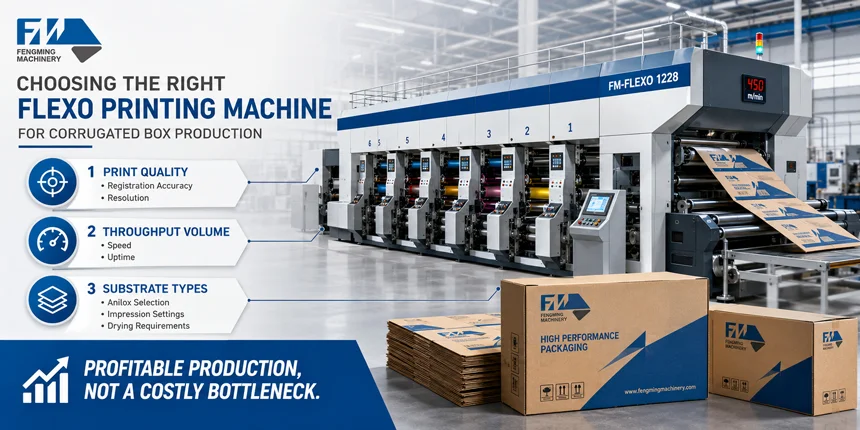
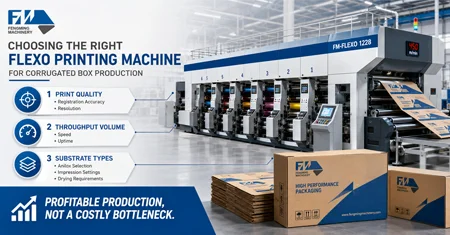
Short answer: The right flexo printing machine for your corrugated box operation depends on three core factors: the print quality your customers require (measured by registration accuracy and resolution), the throughput volume you need to achieve (balancing speed against real-world uptime), and the substrate types you will run (which determine anilox roll selection, impression settings, and drying requirements). These variables collectively determine whether a machine delivers profitable production or becomes a costly bottleneck.
This article provides a structured decision framework that moves beyond brochure specifications. You will learn how to translate technical parameters into business impact, compare machine types against your specific application needs, and avoid the most common mistakes that lead to costly mis-purchases.
This is not a generic product introduction. This guide offers:
A quantifiable decision framework that ties technical specifications to production outcomes
Real-world calculation examples that convert speed and efficiency specs into hourly output and operating cost estimates
Industry-standard references (ISO 12647-6, ISO 12100, FIRST guidelines) that establish objective evaluation criteria
Application-specific comparisons that match machine configurations to different box types and customer requirements
Field-based insights on common mistakes and practical workarounds observed in corrugated printing operations
Definition: Registration accuracy refers to the precision with which multiple colors align on the printed substrate. In flexographic printing, misregistration occurs when successive color layers do not land in their intended positions, resulting in blurry images, color bleeding, or illegible text.
Why it matters: For corrugated box printing, registration accuracy directly determines whether your output meets brand color standards. A tolerance of ±0.1 mm is generally considered acceptable for high-quality printing. Modern high-end systems can achieve ±0.05–0.15 mm, while conventional production lines often operate at ±0.10–0.30 mm.
Common mistake: Buyers often assume that registration accuracy is purely a machine specification. In reality, it depends on plate mounting precision, substrate consistency, and environmental conditions. A machine quoted at ±0.1 mm may not deliver that accuracy with poor-quality plates or variable board thickness.
Decision impact: If your customers require high-fidelity graphics (retail displays, brand packaging), prioritize machines with servo-driven individual print units and CCD automatic registration systems. For industrial boxes where color alignment is less critical, a wider tolerance may be acceptable and can reduce equipment cost.
Definition: The anilox roll is the "heart" of the flexographic press—a ceramic-coated cylinder engraved with millions of tiny cells that carry a precise volume of ink to the printing plate. Two key metrics define anilox performance: LPI (lines per inch, the cell count along the engraving axis) and BCM (billion cubic microns per square inch, the ink-carrying volume).
Why it matters: LPI and BCM together determine ink film thickness, color density, and print sharpness. For corrugated board printing, higher-volume anilox rolls are generally required to compensate for ink absorption into the liner layer of the corrugated sheet. Typical ranges in the sheet-fed corrugated industry span from approximately 200 LPI with 9.5 BCM to 400 LPI with 4.5 BCM, depending on graphic requirements and board type.
Common mistake: Selecting too fine an anilox (high LPI, low BCM) for coarse substrates like brown kraft results in insufficient ink coverage and washed-out solids. Selecting too coarse a roll sacrifices detail and edge sharpness.
Decision impact: The right anilox specification depends on your typical substrate and graphic requirements. Brown kraft boxes with heavy solids need lower LPI/higher BCM; coated boards with fine process work need higher LPI/lower BCM. A machine that offers interchangeable anilox rolls gives you flexibility across job types.
Before evaluating specific machines, answer these five questions:
What box types and substrates will you primarily print? Single-wall vs. double-wall corrugated, brown kraft vs. coated vs. mottled white—each has different ink absorption and compressibility characteristics that affect anilox selection and impression settings.
What print quality do your customers demand? Are you printing simple shipping boxes with line art and large text, or retail-ready displays requiring halftones, fine type, and precise brand color matching? This determines required registration accuracy, resolution, and color station count.
What is your target throughput? How many boxes per hour or per shift do you need to produce? This determines required speed, but remember that real-world throughput is always lower than maximum rated speed.
What is your existing finishing capability? Do you need an integrated printing-slotting-die-cutting line, or do you have separate finishing equipment? Inline integration reduces material handling but increases machine complexity and cost.
What is your energy and operating cost sensitivity? Drying systems are among the largest energy consumers in flexo printing. If energy costs are a major concern, evaluate drying technology options carefully.
For application-specific considerations, review our guide to customization options for flexo presses.
| Evaluation Factor | Stack Press | Inline Press (with Slotter) | Central Impression (CI) Press | Business Impact | Best-Fit Scenario |
|---|---|---|---|---|---|
| Registration Accuracy | ±0.15–0.30 mm (typical) | ±0.10–0.25 mm | ±0.05–0.15 mm (highest) | Tighter registration enables higher-quality graphics but requires more precise setup and maintenance | CI for high-fidelity graphics; stack for industrial boxes |
| Max Print Speed | 150–250 m/min | 80–200 m/min | 400–600 m/min | Higher speed increases theoretical output but real-world throughput depends on setup time and uptime | CI for high-volume long runs; stack/inline for medium volumes |
| Substrate Flexibility | Good for corrugated board | Good for corrugated, can integrate with finishing | Excellent for films and flexible packaging | Broader substrate range means more job types but may require more adjustments | Stack for dedicated corrugated; CI for mixed substrate operations |
| Drying System Options | Hot air + IR typically | Hot air + IR, some UV | Hot air + IR, advanced options | Drying affects speed, energy cost, and print quality on absorbent substrates | All types; evaluate energy efficiency of each option |
| Integration | Standalone printing | Printing + slotting + die-cutting in one pass | Standalone printing, often with unwind/rewind | Integrated lines reduce handling and labor but increase capital cost and complexity | Inline for high-volume finished box production |
| Footprint | Compact | Moderate | Largest (due to large central drum) | Space constraints may limit options in existing facilities | Stack for space-constrained plants |
| Typical Application | Corrugated boxes, rigid substrates | Finished corrugated boxes with slotting/die-cutting | Film, flexible packaging, high-quality corrugated preprint | Match machine type to your primary product mix | Match to your dominant box type and volume |
Note: Speed and accuracy estimates represent typical industry ranges and vary by manufacturer, substrate, and press condition.
A common trap in equipment selection is comparing maximum speeds without accounting for real-world operational losses.
Given:
Machine A rated max speed: 200 m/min
Machine B rated max speed: 150 m/min
Average web width: 1,200 mm
Typical box length: 600 mm (2 boxes per meter of web)
Estimated operational losses (setup, cleaning, splices, stops): 20% of production time
Calculation:
Machine A theoretical output:
200 m/min × 60 min = 12,000 m/hour
12,000 m/hour × 2 boxes/m = 24,000 boxes/hour theoretical
24,000 × 0.80 (20% loss) = 19,200 boxes/hour effective
Machine B theoretical output:
150 m/min × 60 min = 9,000 m/hour
9,000 m/hour × 2 boxes/m = 18,000 boxes/hour theoretical
18,000 × 0.80 = 14,400 boxes/hour effective
Interpretation: The 50 m/min speed advantage translates to approximately 4,800 more boxes per hour—a 33% production advantage. However, if Machine A requires longer setup times (more color stations, more complex registration) that increase downtime to 30%, its effective output drops to 16,800 boxes/hour, reducing the advantage to only 17%.
Decision takeaway: When comparing speed specifications, always ask about real-world uptime and setup time. A slightly slower machine with faster changeovers and higher reliability may outperform a faster machine with frequent stoppages.
Drying is one of the largest energy consumers in flexo printing, accounting for a significant portion of total electricity use.
Given:
Typical flexo press drying system power: 100–200 kW depending on configuration
Operating hours: 4,000 hours/year (2 shifts, 5 days/week)
Electricity cost: $0.12/kWh (typical industrial rate in many markets)
Calculation:
Annual energy consumption: 150 kW average × 4,000 hours = 600,000 kWh/year
Annual energy cost: 600,000 × $0.12 = **$72,000/year**
With energy-efficient IR drying (up to 30% reduction reported):
Reduced consumption: 600,000 × 0.70 = 420,000 kWh/year
Reduced cost: $72,000 × 0.70 = **$50,400/year**
Annual savings: approximately $21,600
Interpretation: Over a 10-year equipment life, the energy-efficient drying system could save over $200,000 in electricity costs alone, not counting the value of reduced heat load on facility cooling systems.
Decision takeaway: When comparing presses, request energy consumption data for the drying system. The premium for efficient drying technology often pays back within 2–3 years through lower operating costs.
What it covers: This international standard specifies requirements for the exchange of data and information necessary for defining the aims for four-color flexographic printing of packaging and publication materials, including labels, boxes, and flexible packages. It establishes process parameters and tolerances for color reproduction in flexographic printing.
Why it matters for buyers: Compliance with ISO 12647-6 indicates that a machine and its associated process controls can achieve internationally recognized color quality standards. For brands requiring consistent color across multiple packaging suppliers, this standard provides a common reference.
Decision implication: If your customers require color consistency certifications, prioritize machines and suppliers that demonstrate ISO 12647-6 compliance. Ask potential suppliers whether their machines have been validated against this standard.
What it covers: ISO 12100 sets the methodology for identifying hazards, estimating and evaluating risks, and implementing protective measures in machinery design. For flexo presses, this translates to requirements for guarding of nip points, solvent ventilation, and safe handling of anilox rolls and doctor blades.
Why it matters for buyers: Machine safety compliance is not optional—it affects operator safety, regulatory approval (CE marking in EU, OSHA compliance in US), and liability exposure.
Decision implication: Verify that any machine you consider meets ISO 12100 and has appropriate CE marking or OSHA-compliant safeguarding. Request documentation of risk assessments and safety function design.
What it covers: FIRST is an industry-developed specification system promoted by the Flexographic Technical Association (FTA) that provides guidelines for achieving consistent, predictable flexographic print quality. It covers everything from prepress to pressroom process control.
Why it matters for buyers: FIRST provides a practical framework that translates ISO standards into actionable pressroom procedures. Suppliers who follow FIRST guidelines typically demonstrate stronger process control capability.
Decision implication: Ask potential suppliers about their familiarity with FIRST and whether they provide training or support for FIRST-compliant operation.
What to do: Document the box types, substrates, and print quality levels you need to produce. Include:
Maximum and minimum box dimensions
Board types (single-wall, double-wall, coated, uncoated)
Number of colors required (typically 1–6 for corrugated)
Required resolution and registration tolerance
Expected monthly/annual volume
Why it matters: These parameters determine the minimum specifications your machine must meet. Over-specifying wastes capital; under-specifying limits your business.
How to judge: If you are unsure of future requirements, choose a machine with some upgrade flexibility (additional color stations, anilox roll interchangeability, modular drying options).
Avoid: Buying based on a single "hero" job that represents less than 10% of your volume.
What to do: Evaluate whether you need a standalone printing press or an integrated printing-slotting-die-cutting line.
Why it matters: Integrated lines reduce material handling, labor, and work-in-process inventory but increase machine complexity and capital cost.
How to judge: If you produce finished boxes in high volume and already have or plan to acquire slotting/die-cutting capability, an inline press may be optimal. If you print sheets for downstream finishing, a standalone press may suffice.
Avoid: Assuming integration is always better—it adds complexity and single-point-of-failure risk.
What to do: Request and review actual print samples from the machines you are considering—not just marketing materials, but samples on substrates similar to yours.
Why it matters: Registration accuracy, dot gain, and color consistency vary significantly with substrate and operating conditions.
How to judge: Measure registration marks on samples (target ±0.1–0.15 mm for quality work). Examine halftone dots for roundness and even spacing. Check for dot gain variation across the sheet.
Avoid: Relying solely on brochure specifications without verified samples.
What to do: Calculate your required effective hourly output using the method shown in the Data Recalculation section. Then compare machine specifications against this requirement.
Why it matters: Maximum speed is rarely achieved in production. Setup time, changeovers, and unscheduled stops significantly affect output.
How to judge: Ask suppliers for data on typical setup times, changeover times between jobs, and expected uptime (OEE). Request references who run similar substrates and volumes.
Avoid: Being impressed by high maximum speed numbers without understanding the conditions required to achieve them.
What to do: Compare drying technology options—hot air, IR, UV, and hybrid systems. Request energy consumption data.
Why it matters: Drying accounts for a major portion of operating cost. The right system also affects print quality and maximum achievable speed on absorbent substrates.
How to judge: Calculate the energy cost impact using the method shown earlier. Consider the value of heat recovery systems.
Avoid: Selecting a machine based solely on purchase price without considering lifetime energy costs.
What to do: Evaluate potential suppliers on technical expertise, installation support, training, and after-sales service availability.
Why it matters: Even the best machine underperforms without proper installation, operator training, and ongoing support.
How to judge: Request customer references. Ask about spare parts availability and response times for service calls. Inquire about training programs.
Avoid: Choosing a supplier based solely on lowest price without verifying support capability.
To understand configuration differences across product lines, review compare flexo press architecture types.
Description: A packaging converter producing retail-ready corrugated displays with 4–6 colors, halftones, and precise brand color matching. Volumes exceed 10 million boxes annually.
Key priorities:
Registration accuracy of ±0.1 mm or better for multi-color alignment
Consistent color reproduction across long runs
High throughput with minimal downtime
Common risk: Overlooking the importance of anilox roll selection. Coated display boards require different anilox specifications than brown kraft. Using the wrong roll compromises color density and detail.
Decision logic: A CI or high-end inline press with servo-driven individual print units, CCD auto-registration, and multiple anilox roll sets. Prioritize machines validated against ISO 12647-6.
Description: A box plant producing a wide variety of industrial shipping boxes—brown kraft, single-wall and double-wall, 1–3 colors, mostly line art and large text. Job runs range from 5,000 to 500,000 boxes.
Key priorities:
Fast changeover between jobs
Reliable operation on variable substrates
Good cost-per-box economics
Common risk: Choosing a machine with too many features (and too high a price) for what is essentially a commodity product. Conversely, choosing a machine that cannot handle the occasional higher-quality job.
Decision logic: A stack press or inline flexo press with 2–4 color stations, quick-change plate mounting, and versatile anilox roll options. Prioritize reliability and ease of maintenance over maximum speed.
Description: A growing converter producing short-to-medium runs of custom boxes for e-commerce and specialty retail—frequent job changes, varying substrates, 1–4 colors.
Key priorities:
Quick setup and changeover
Substrate flexibility
Ability to handle both simple and moderately detailed graphics
Common risk: Sacrificing print quality for speed. Short-run customers often have high quality expectations despite lower volumes.
Decision logic: An inline press with servo-driven units for fast registration setup, quick-change plate and anilox systems, and a user-friendly control interface. Consider machines with automated pre-registration to reduce setup time.
For a broader discussion of application-specific configurations, see customization options for flexo presses.
What we observe: Many buyers focus exclusively on running speed when comparing machines, yet setup time often has a greater impact on overall productivity—especially for plants running frequent job changes. A machine that takes 45 minutes to set up for a new job versus one that takes 15 minutes loses 30 minutes of production per changeover. For a plant with 10 changeovers per shift, that's 300 minutes (5 hours) of lost production daily.
What it means: A slightly slower machine with fast changeover capability may outperform a faster machine with lengthy setup requirements. Evaluate total job turnaround time, not just running speed.
Practical takeaway: When comparing machines, ask for documented setup times. Request a demonstration that includes a full job changeover, not just running at speed.
What we observe: Some buyers assume one anilox roll specification will work for all their jobs. In practice, brown kraft boxes with heavy solids need lower LPI/higher BCM rolls, while coated boards with fine graphics need higher LPI/lower BCM rolls.
What it means: A machine with a single anilox roll is limited to a narrow range of jobs. The cost of additional anilox rolls is modest compared to the revenue lost from jobs you cannot run well.
Practical takeaway: Budget for at least two anilox roll specifications—one for your dominant substrate and one for your most demanding graphics work. The ability to change rolls quickly is a valuable feature.
What we observe: Print quality problems on corrugated—dot gain, striping, inconsistent density—often trace to incorrect impression pressure. The general rule for pressure setting is "board thickness + 0.1–0.3 mm," but this must be adjusted for actual conditions. Excessive pressure crushes the fluting and causes dot gain; insufficient pressure results in poor ink transfer.
What it means: Machine design that makes pressure adjustment easy and repeatable has a direct impact on print quality consistency.
Practical takeaway: Evaluate the press's impression adjustment mechanism. Digital or servo-controlled pressure setting with memory for repeat jobs is a significant productivity advantage over manual adjustment.
A flexographic printing machine for corrugated boxes is a printing press that uses flexible relief plates to transfer ink onto corrugated board. It is the dominant technology for corrugated packaging because it balances high speed, substrate tolerance, and cost efficiency, supporting water-based and UV inks with quick changeovers.
Choose based on three factors: print quality requirements (registration accuracy of ±0.1–0.3 mm is typical), throughput needs (match effective hourly output to your volume), and substrate types (determine anilox roll specifications and impression settings). Match machine type—stack, inline, or central impression—to your production flow.
The most common mistake is comparing maximum speed specifications without accounting for real-world downtime from setup, changeovers, and unscheduled stops. A machine with lower maximum speed but faster changeovers and higher reliability often delivers greater effective throughput.
Key standards include ISO 12647-6 for print process control, ISO 12100 for machinery safety, and FIRST (Flexographic Image Reproduction Specifications & Tolerances) for industry best practices. Regional requirements include CE marking in the EU and OSHA compliance in the US.
Registration accuracy is the precision with which multiple colors align on the printed substrate. For corrugated boxes, typical tolerances range from ±0.1 mm for high-quality work to ±0.3 mm for industrial applications. Poor registration causes blurry images, color bleeding, and illegible text, directly impacting brand perception and box readability.
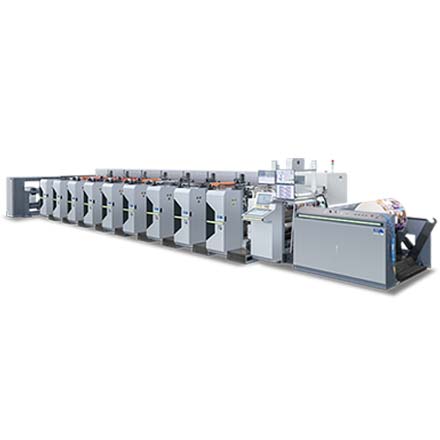
Q1: What is the difference between stack, inline, and central impression flexo presses? Stack presses have printing units stacked vertically, offering a compact footprint and cost advantage for rigid substrates like corrugated board. Inline presses integrate printing with slotting and die-cutting in one pass, ideal for finished box production. Central impression (CI) presses have a large central drum that supports all print units, delivering the highest registration accuracy for film and high-quality work.
Q2: How does anilox roll selection affect print quality on corrugated board? Anilox roll LPI (lines per inch) and BCM (ink volume) determine ink film thickness and print sharpness. Corrugated board typically requires higher-volume rolls (lower LPI, higher BCM) to compensate for ink absorption into the liner. Typical ranges are 200 LPI with 9.5 BCM to 400 LPI with 4.5 BCM, depending on graphic requirements and board type.
Q3: What registration accuracy can I expect from a corrugated flexo press? Typical achievable registration accuracy ranges from ±0.05 to ±0.15 mm for high-end systems with servo drives and CCD auto-registration. Conventional production lines often operate at ±0.10 to ±0.30 mm. For most corrugated applications, misregistration under 0.1 mm is considered acceptable for high-quality printing.
Q4: What are the most important quality metrics for corrugated flexo printing? The key metrics are: registration accuracy (color alignment), color accuracy (measured by ΔE value, with <3 considered acceptable for most packaging), print resolution (typically 100–150 dpi for corrugated)[reference:93], and ink density (measured by densitometer). Dot gain control is also critical, as corrugated fluting causes variable dot gain across the sheet.
Q5: How much energy does a flexo press drying system consume? Drying is one of the largest energy consumers in flexo printing. A typical press drying system may draw 100–200 kW. Energy-efficient IR systems can reduce consumption by up to 30% compared to conventional IR dryers. Over a year of operation, this can translate to tens of thousands of dollars in energy savings.
Q6: Should I buy an integrated printing-slotting-die-cutting line or separate machines? Integrated lines reduce material handling, labor, and work-in-process inventory—typically lowering cumulative energy use per finished carton. However, they increase capital cost and create a single point of failure. Choose integrated if you produce finished boxes in high volume; choose separate machines if you need flexibility or already have finishing equipment.
The most reliable way to choose a flexo printing machine for corrugated boxes is to compare print quality capability, real-world throughput, and operating cost against your specific application requirements—not to rely on a single specification like maximum speed.
Three core decision dimensions:
Quality fit: Match registration accuracy, resolution, and color capability to your customers' requirements. If brand consistency matters, prioritize ISO 12647-6 compliance and CCD auto-registration.
Volume fit: Calculate your required effective hourly output, not just maximum speed. Account for setup time, changeovers, and expected uptime. A slightly slower machine with faster changeovers may outperform a faster machine with longer downtime.
Cost fit: Consider total cost of ownership—energy consumption (especially drying), maintenance requirements, and consumable costs—not just purchase price. Energy-efficient drying systems can save over $20,000 annually.
The decision framework is simple: define your requirements, match machine type to your production flow, verify capability with actual samples, and calculate real-world economics. Then choose the machine that best balances these factors for your specific operation.
For broader technical context on flexographic printing equipment, read *compare flexo press architecture types. *
Flexo Printing Machine Types: Stack vs. Inline vs. Central Impression — A Comparative Overview
How to Calculate Total Cost of Ownership for Corrugated Printing Equipment
Understanding Anilox Roll Selection for Corrugated Board Printing
Energy Efficiency in Corrugated Box Printing: A Buyer's Guide
Quality Control Standards for Flexographic Packaging Printing
Common Flexo Printing Defects and How to Prevent Them
This article is for informational and educational purposes. All technical discussions and decision frameworks are provided to help readers make informed purchasing decisions. No direct sales, pricing, or promotional information is included. — Fengming Machinery
GET A QUOTE